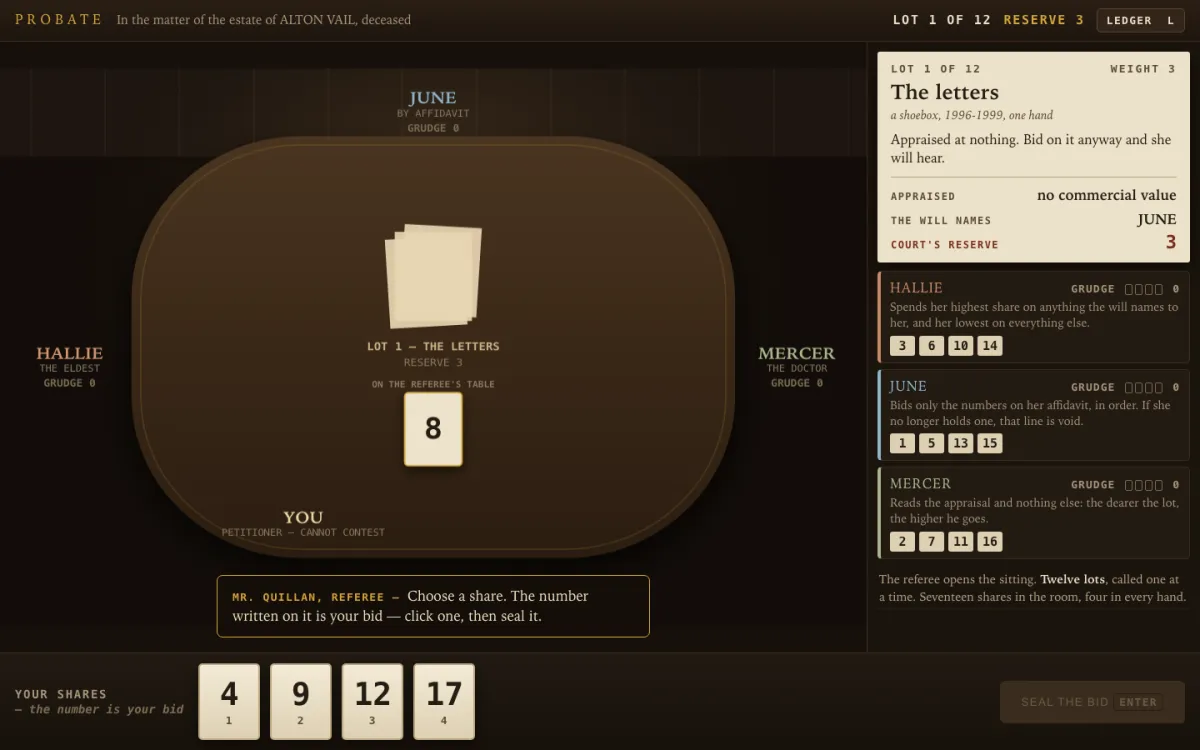
LOT 1 OF 12WEIGHT 3
The letters
a shoebox, 1996-1999, one hand
Appraised at nothing. Bid on it anyway and she will hear.
- APPRAISED
- no commercial value
- THE WILL NAMES
- JUNE
- COURT'S RESERVE
- 3
A free browser game about an inheritance. Twelve lots, four heirs, about five minutes.
Your father left the estate to "my children, as they can agree." You can't agree, so the probate court auctions it to the four of you, one lot at a time. Everybody bids face down. Everybody's hand is face up. And your sister June didn't come: she filed her bids in writing before the sitting.
Lot 1 of 12
This is the game's own engine, running in this page, on a real estate. Your four shares are at the bottom. The number on a share is your bid. Pick one and seal it.
The demo needs JavaScript. The game itself is one click away below.
a shoebox, 1996-1999, one hand
Appraised at nothing. Bid on it anyway and she will hear.
Same estate, from lot 1. Free, no account, runs in this tab. Mouse or keyboard. Made for a laptop or desktop screen.
The reserve
Here's the part that took me a minute.
Every lot carries a reserve, printed on the card. Nobody beats it, nothing is sold, and the lot goes free to whoever the will names. The court sets the reserve from the appraisal. Take the lake lot. It's worth $3,200, so its reserve is 13: the court won't sell it for less than a 14. Mercer bids his highest share on it anyway.
The letters are worth nothing. In the demo's estate their reserve is 3, so any share from 4 up clears it. The court isn't the problem. June filed a 15 on them, so only your 17 takes them.
That's the trick of the whole game. The court protects money. It doesn't protect what somebody loved.
So every lot also has a weight, from 1 to 3, and that's the other price. When anybody takes a lot the will names to somebody else (you or a sibling), that heir's grudge goes up by its weight. The letters weigh 3. So does the lake lot ("Mercer paid those taxes for eleven years."). The china weighs only 1.
A $0 shoebox and a $3,200 lake lot cost you the same with the person who wanted them.
The rules of the sitting
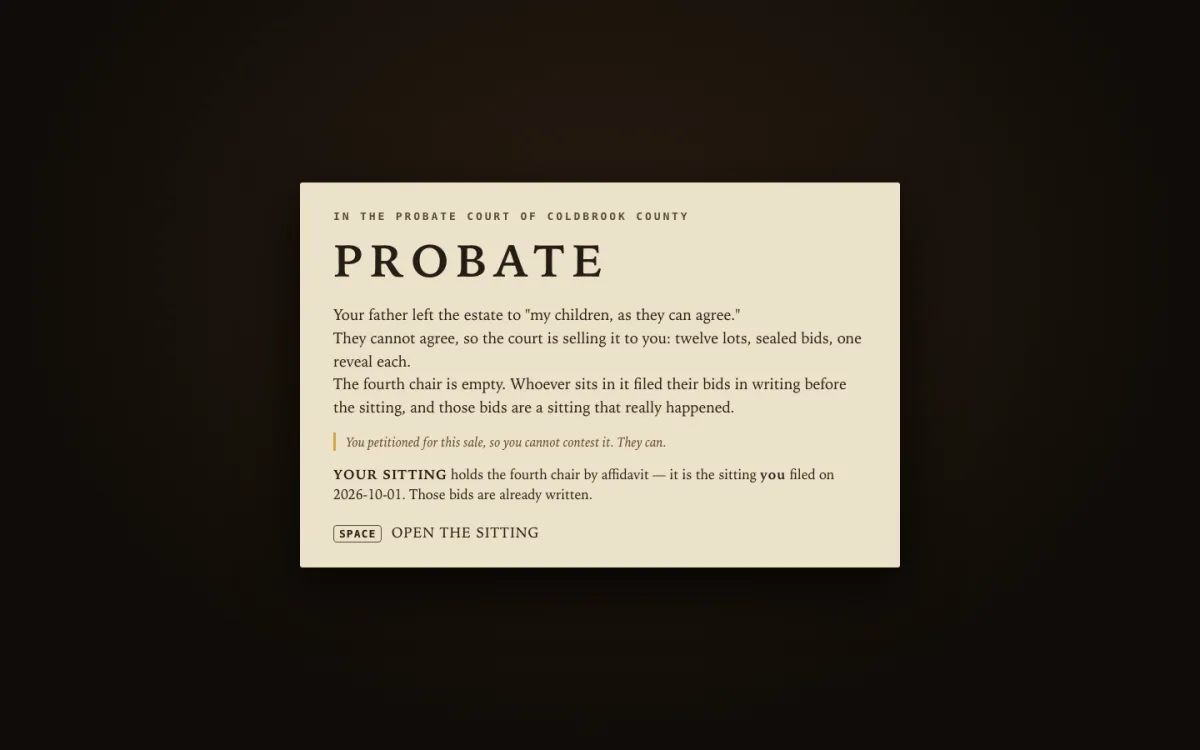
You can't contest. The title screen says why: "You petitioned for this sale, so you cannot contest it. They can."
Mr. Quillan, the referee, explains each rule the first time it comes up, in a sentence or two, and then gets out of your way.
The fourth chair
June filed one number per lot before the sitting. Her rule is printed in the game, word for word:
"She filed one number per lot, in order, before the sitting. If she still holds that number, she bids it. If she does not, the line is void and she does not bid. A void line is never re-filed. She cannot see this sitting."
So June can't react to you. But you can wreck her plans without meaning to. Take a lot she was counting on, and the share she expected to pick up never reaches her hand. Every later line that filed that share goes void.
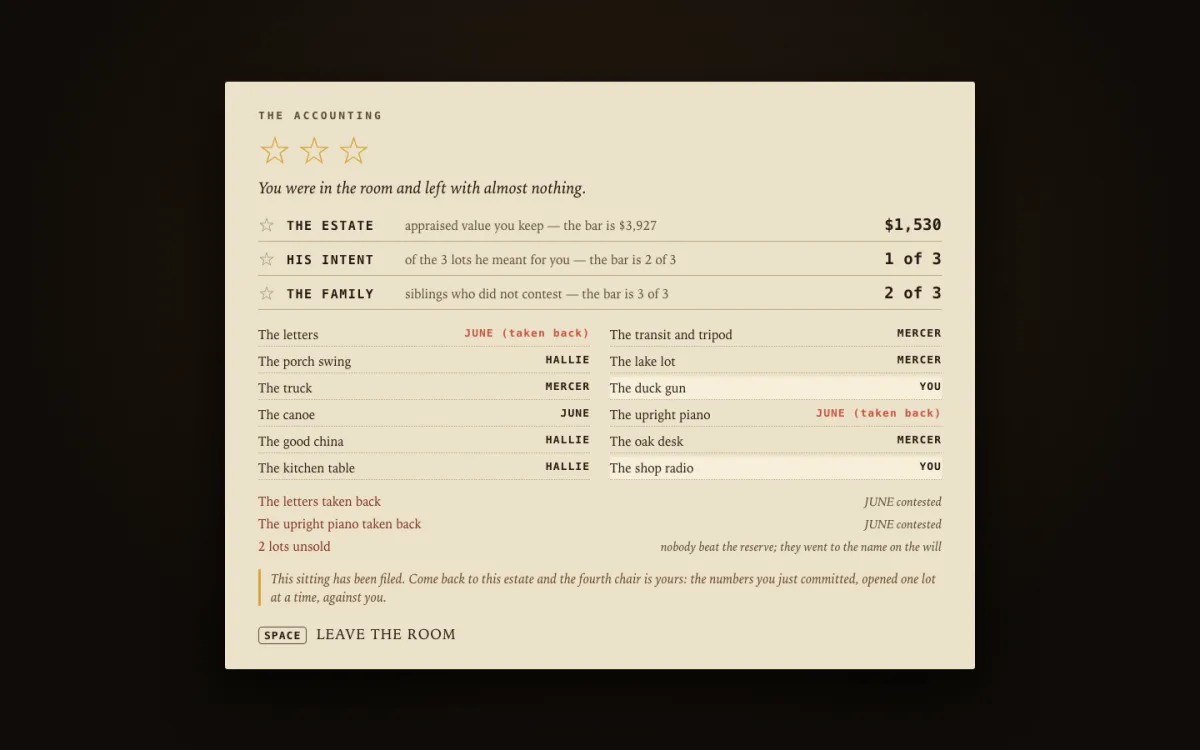
Here's what that looks like in the estate from the demo. If you take the letters with your 17, June never picks up the 8 from the table. She filed that 8 on five later lots, so all five lines go void. One of them is lot 10, her own piano. She can't bid on it. Mercer takes it, her grudge hits 6, and she contests. At the accounting the letters go back to her.
(After lot 1, the rest of that run was played by the game's balanced bot. I also ran it with the bot that bids its highest share on every lot and the one that only bids on its own lots. All three finished at zero stars. Bid a 4 on the letters instead, let June have them, and the same balanced bot finishes the estate with all three.)
And here's the part I like best. Finish a sitting and it's filed. Come back to the same estate and the fourth chair is you: every number you committed, opened one lot at a time, against you.
A memory can sue you.
The table
No sibling peeks at your bid. Each one's habit is printed on their card from the first lot:
Reading the table is most of the skill. Hallie will go all in on the kitchen table ("She has served every meal in this house on it for four years."), so don't fight her for it with a 12. Mercer will chase the truck because it's worth $2,900. You'll want the truck too, since it's named to you.
The accounting
After lot 12 the whole board comes up one last time: who holds what, what's being taken back, and by whom. Then three rows, one star each.
Take everything and it gets taken back. Keep the peace at any price and THE ESTATE star usually goes with it. Nobody fails: a bad sitting still gets graded.
I ran the game's bots through 200 estates to see which habits pay. A bot that takes what's named to it, buys value with the cheapest share that clears the reserve, and never makes the bid that sends someone to a lawyer averaged 2.19 stars out of 3. Siblings still contested 0.24 times a sitting, every time over a lot one sibling took from another. A bot that bids its highest share on every lot averaged 1.39 stars and saw 1.55 contests a sitting. June contested in 61% of those estates.
Those are bots. Nobody outside of development has played it yet.
Free, no account, runs in this tab. Made for a laptop or desktop screen.
Before you sit down
It's for you if you like auction games where you can read the table (fans of Ra will recognise the rotating shares, and fans of For Sale the face-down flip), or story games where the rules carry the story.
It's probably not for you if you want something fast. Each lot is a sealed bid and a flip, and the thinking happens before the flip.
Honest gripes:
Questions for the referee
The sitting is open
Free, no account, runs in this tab.